Showing posts with label church. Show all posts

Tuesday, September 30, 2008

It's okay, Catholics, we can laugh


"The Book of Catholic Jokes,"

by Deacon Tom Sheridan


Did you know that they had automobiles in Jesus' time?

Yes, the Bible says that the disciples were all of one Accord.


Yeah, you may have heard some of them before.

And yes, Tom Sheridan admits that some of these may have been jokes to which a Catholic angle has been added to make them churchy.


But Sheridan, who was a writer and editor for the Chicago Sun-Times before he was a deacon, has nicely selected jokes that folks with decent moral standards can tell in polite company, and Acta Publications has packaged them well as a handy little and inexpensive paperback.


Did you hear the one about the man who opened a dry-cleaning business next door to the convent? He knocked on the door and asked the Mother Superior if she had any dirty habits.


To be sure there are some clinkers in the bunch, and some moldy oldies. And I don't know why every priest in a joke has to have an Irish surname; hell0 -- you don't have to be Irish to be a priest, or to be funny.


With most of the quips you don't have to be an "insider," so to speak, although I'm not sure the jokes that take off on the differences between, say, the Franciscans and the Jesuits, aren't going to have some Catholics scratching their heads. But maybe not.


For the most part the collection is good stuff -- good enough to make you crack a smile even though you may have heard them before.


There's at least one great priest golf joke, a cute one about a rabbi and a priest, a funny Pope Benedict XVI joke and a clever atheist joke. And as someone who can rarely remember a joke, what a good resource; I'm sure "The Book of Catholic Jokes" will end up on a number of reference shelves in rectories. -- bz


One Sunday morning a priest saw a little boy staring intently at the large plaque on the church wall. The plaque was covered with names, and flags hung on either side of it.

"Father," asked the boy, "what's this?"

He replied, "It's a memorial to all the men and women who died in the service."

They stood together in silence for a moment. Finally, the boy asked with genuine concern: "Was it at the eight or the ten-thirty Mass?"


Friday, July 18, 2008

Good tools for passing on the faith

"Learning Centers for Advent and Lent,"
by Doris Murphy

Doris Murphy is doing her best to make it painless for families to grow in their Catholic faith.

From her experience as Director of Faith Formation at St. Bridget Parish in River Falls, Wis., Murphy has gathered easy projects that parents can work on with their children, projects that will help these "first teachers" of their young ones develop the foundation for a life enriched by the knowledge and traditions of Catholicism.

As she has for First Reconciliation, First Eucharist and the Whole Community in earlier books put out by Twenty-Third Publications, Murphy utilizes the learning center approach to enable parents to be those first teachers of the faith that they are called to be for the seasons of Advent and Lent, too. In the learning center methodology, the parish gathers needed material and instructions, then invites parents to use age-appropriate activities that have hands-on tasks, that invite talking with their children about their faith, all the time reinforcing material the children may be learning in their faith formation textbooks and classes.

It's handing on the faith through example, through family rituals and through conversation. As important as the projects' purposes are, maybe even more important is the time a parent spends with a child around something of a religious nature: It enables adults -- the most influential people in a child's life -- to both tell and show a child that their own faith is important to them and that it's a faith full of meaning and history, something to be greatly valued, remembered and cherished.

For Advent and Lent, Murphy's workbook of just over 100 pages offers fun, easy, purposeful ideas that any parish, any director of faith formation, any catechist or any parent will find helpful.

It's a how-to book from the word go, full of practical projects and turn-key materials, and DREs might find these ideas are worth a try. If they work in River Falls, Wis., maybe they'll work for you. -- bz

Thursday, July 3, 2008

'To forgive, divine'

"The Forgiveness Book,"
by Alice Camille & Paul Boudreau

and

"The Power of Forgiveness,"
by Kenneth Briggs

Two very different approaches tackling the same subject isn't unique. Two very different books tackling the same subject happens frequently.

But that authors tackle the same subject for the same reason -- that a book on forgiveness has never been more needed -- maybe that's a message that the subject is not just interesting but vital.

Just over 100 pages long -- counting the useful and worthwhile appendix -- "The Forgiveness Book" is an easy read that offers countless good reasons for making a "divine" response when others err.

Camille, an award-winning writer and Father Boudreau, an oft-published priest-columnist, come at the rationale for forgiveness from an admittedly Catholic perspective. This is a little book laced with down-to-earth reasoning that explains significant theology in simple, easily understood language.

Alternatives no bargain
They acknowledge that forgiveness is "an ugly job," but that "the alternative to forgiveness is far uglier: hardened hearts, broken relationships, memories full of shrapnel, and families or communities paralyzed and divided."

If we don't choose to forgive, we get trapped in the addictive pattern of condemnation, blaming, open hostility, self-righteousness, hidden resentment, cold anger, cynicism -- the list goes on and on -- and the one we do the most damage to is ourselves, because not to forgive "weighs us down, saps our energy, hurts our bodies and leaves us weary."

There is a platitude or two of advice here, but most helpful is a brief, seven-point list of what forgiveness is -- and what it is not. Importantly, the authors aren't afraid to address the concept of sin, and do so in the healthy express of "missing the mark" in what we ought to be aiming at in our actions, decisions and relationships.

They stress that forgiveness is a choice, and the Sacrament of Reconciliation gets high marks as a structure that makes that choice easier.

Camille and Boudreau summarize their work well:

"Forgiveness is not just a thing nice people do. It's not a tactic we might consider for personal improvement or to tidy up our spiritual lives. As the world we live in spirals toward greater feats of injustice, greed, violence and bigotry, the reasons to forgive mount astronomically. The cost of unforgiveness, too, becomes ever more apparent. . . . The human race must learn to forgive, to practice forgiveness, to choose it, to seek it, to value it, and to want it. That means each of us individually must do the same, because the whole world begins in the human heart."

From film to print
Kenneth Briggs' "The Power of Forgiveness" is based on a film by Martin Doblmeier and delves into the topic by looking at specific instances of forgiveness and analyzing them, then going several steps deeper.

The most recent, the murder spree that left five Amish schoolchildren dead and five wounded in a Pennsylvania classroom, is the opening to view forgiveness from the religious perspective. The most interesting portion of this was Briggs' parsing of the idea that the Amish' forgiveness of the madman murderer was "a spiritual reflex," something the Amish learn "by watching parents and neighbors forgive and by looking at the example of Jesus."

Several of the world's religions get a similar analysis.

A section on the sociological perspective wonders if those who forgive may be healthier than those who don't. Another chapter discusses how very difficult -- even impossible -- forgiveness can seem. There's brief mention of the death penalty debate and the film "Dead Man Walking," plus the complex grief of a mother of a New York City firefighter who died on 9/11, and even a few paragraphs that touch upon the sex abuse scandal in the Catholic Church.

The most interesting quote from that latter part?

"Somehow a refusal to pardon guilty priests provides a balance to years of having forgiven them too much. . . . For most lawyers fighting for huge cash settlements, forgiveness is unthinkable, even laughable."

There's much more, but let me recommend this book by quoting from one quoted in it, author and lecturer Marianne Williamson:

"At a time when we see so much evil, we are called upon . . . to stand for the possibility of human redemption that turns even the hardest of hearts." -- bz
Wednesday, June 18, 2008

Can you live like a monk? To create a better world, maybe we all should!

"Finding the Monk Within: Great Monastic Values for Today,"
by Edward C. Sellner

We would live more fulfilling lives -- and our 21st-Century society would be a better off -- if we were to adopt the values lived by monks and monastic communities through the ages.

That's the message Ed Sellner delivers as he shares the wise ways of holy people who lived the ascetic life in various ways since the times of the early church. He summarizes it so well with his perceptive concept that every person today needs "to live simply, to pray often, and to choose well," but there's so much more that adds practical, concrete approaches that anyone can take up -- and not have to move to a monastery to do so.

Sellner, who teaches at the College of St. Catherine in St. Paul, has really done yeoman's work here in this HiddenSpring publication by Paulist Press. The 272-page book -- minus notes -- takes readers on a journey through the lives of a handful of monastic "celebrities," if you will.

Chapters include the likes of Athanasius of Alexandria, Antony of Egypt, Martin of Tours, Hilary of Poitiers, Augustine and Monica, Brigit of Kildare, Gregory the Great, Benedict and Scholastica, and Bernard of Clairvaux, among others. Sellner shows how the monastic tradition grew and developed from the Third Century in the Middle East to Europe in the Middle Ages as monastics learned from their elders and added charisms that were needed at their time in history.

The stories of these saintly folks aren't always compelling reading, but there are enough passages of interesting details in their lives that will keep a reader moving through the pages. The gift of this work, though, is that Sellner consistently brings the reader back to the values these ancient folks practiced and why those values are important for those of us currently on the planet.

Which holy figures teach what values?
  • Athanasius: Sharing stories, "and that one does not have to be a monk in a monastery to live out monastic values today."
  • Antony: Silence and solitude, and how they can foster discernment, the ability to begin to see differences between right and wrong.
  • Hilary of Poitiers and Martin of Tours: faith, and its participative and communal dimension.
  • Augustine and Monica: friendship.
  • Jerome, Paula and Eustochium: the need for qualified spiritual mentors.
  • John Cassian and Germanus: the value of disclosing our secrets, plus dedication to inner work.
  • Brigit and other Irish monastics: compassion, and including lay people in monastic communities and women in decision-making and leadership positions.
  • Gregory the Great: contemplation.
  • Benedict and Scholastica: stability and love.
  • Bernard of Clairvaux: learning to read the "book of experience," the book of our lives, as well as the book of our hearts.
Why would anyone wish to follow in the footsteps of the monastic headliners?

To both develop an interior life and to make a difference in the world, according to Sellner. To do so one needs to identify the values the monastics lived and incorporate them into their own deeper selves.

"These are not only monastic values," he writes, "but values of the soul -- and they apply to everyone, regardless of gender, occupation, material status, or place of residence."

Sellner puts it well in his conclusion:

"What our study of monasticism reveals is that to affirm and nurture the growth of the true inner self a 'new monk' must develop an asceticism of loving. This form of asceticism, so much need today, presumes that to love well a person needs discipline, the setting of limits, the investment of time and energy in relationships and work that reflect at least some of the values discussed here.

"Such an asceticism of living involves a commitment to growth in self-knowledge, self-discipline, and self-love, all based upon the profound conviction, so difficult at times to believe, that God created us for a purpose, that God loved us first. To discover this and make this a daily, lived experience, one must learn to listen to the heartbeat of God." -- bz

Monday, June 16, 2008

Conflict boils over in novel about post-Vatican II parish life

"Waiting for Mozart,"
by Charles Pilon


A page-turning novel because of the drama in the conflict, yet not exactly bestseller quality?

Interesting characters, but sometimes quasi-believable stereotypes?

Spot-on lessons for life, yet propaganda-filled
?

The questions were the aftertaste from furiously reading Chuck Pilon’s “Waiting for Mozart.”

It’s a good novel, if you judge by the fact that you just have to keep reading to find out how the conflict is going to end between the pastor and the parish council at fictional St. Mary Parish in fictional Mapleton, Minn.

But the getting there isn’t smooth.

I’m certain there is a parish somewhere where disagreements are unknown, but I’ll bet everyone who has ever been involved with a parish council – or run up against seemingly unreasonable leadership in any setting – will both recognize and empathize with the people caught up in St. Mary’s tempest.

Pilon’s captured the flavor of some of that in the post-Vatican Council II church. Since he formerly served as a priest, I’m sure that he’s writing in part from real-life experiences.

Yet the jagged edges of the writing, the dialogue that just doesn’t sound like any real person speaks, are distracting, from a literary critique point of view. I’d have loved to have read this book after a tougher editor got a hold of the text.

For contrast, think of the crisp repartee in the play “Mass Appeal,” for example, superb writing on a similar subject matter.

As delicately as it is worded, there’s propaganda on these pages, and maybe enough to anger Catholics on several sides of the celibate male priesthood concept. Pilon has an archbishop character predict that, “When the time is right, the Holy Father will make the change in a way that will re-introduce the idea and the practice of having a married clergy. Eventually that will include women.”

That kind of statement would surely earn the darts of one segment of the church, but then the character quickly adds, “That’s my opinion. I think it’s coming, but the Church isn’t ready for it. The people aren’t ready.” And that will just as surely tick off another segment. The permanent diaconate takes a shot as well.

But this is a novel, after all, and it deserves to be read as a novel. The propaganda isn’t hidden, it’s right out there in the open.

And the lessons Pilon shares are worth absorbing, such as:

  • "Sometimes the wrapping is as important as what's in the package....Commitment and being right aren't the only important things. You've got to reach the listener. It's possible to always be right and never be heard."
  • "We've got to keep in mind that the really crucial issues, even in today's church, are few in number. Not many that a guy would want to die for. I don't have to have an answer for everything."
  • "The only day worth living is the day I do something to bring people together."
  • "Be hard on the problem, go easy on the people involved."
  • "When you're in the heat of things, it's hard to remember that war almost never brings peace. You forget that you can't be a reformer if you think in terms of them and us. That way, everyone loses; nobody finds the Grail. You get fixed on final, forever-like answers. You write the last chapters when the story is still unfolding."

So, despite it's lack of perfection, "Waiting for Mozart" is worthy of print and worthy of reading both by the leaders of the church and the People of God, if only so that some of the novel's lessons enter into those contentious times in church life. -- bz

Friday, February 29, 2008

Thanks for the "Pope" pulp, but you shouldn't have

"High Hat,"
by Greg Mandel

I hadn't read four complete paragraphs of "High Hat" when I began asking myself if I'd had enough and it was okay to stop.

The same question came to mind many times, but I kept forcing myself on, just to see if Greg Mandel could pull off this wacky idea of a Mickey Spillane-type pulp fiction novel in which the private detective has a day job -- as the pope, the leader of the Roman Catholic Church.

After plodding through all the obtuse private-eye vernacular for 130 pages, the answer was, "No."

Sorry, Greg. All the kitsch in the world can't save a hokey plot. And how many 130-page paperbacks can you describe as having to plod through?

It's like the author put all the energy into trying to come up with cute similes and metaphors ala Mike Hammer and forgot that realistic drama was an essential element to hold readers' attention.

The storyline has someone trying to get possession of the bones of St. Peter because they allegedly have mysterious powers. The pope, as alter ego A. Pope -- get it? -- Vatican City's only private detective, stumbles on the bad guys and goes through the usual ups and downs the pulp fiction genre requires, getting into as much hot water as, well, as Mandel might have put it, enough hot water to bathe the whole College of Cardinals.

And the creative P-I lingo? Papal garments are call "the holy muumuu;" lips are "ruby smoochers;" the pope never walks anywhere, he "ankles" over; the Mennonite splinter group bad guys are "pretzel benders." All that's campy for a while, and silly almost to the point of funny, but not quite.

Save yourself the two hours. If you need a fix of stuff like this, find a "Batman" rerun on cable TV. That's about the quality of the story and the action -- and you'll only be wasting 30 minutes of your life. -- bz

Thursday, February 7, 2008

Priest gets inside scoop on NY theater scene and theater people

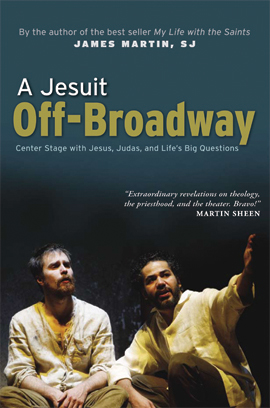
“A Jesuit-Off Broadway: Center Stage with Jesus, Judas, and Life’s Big Questions,” By Father James Martin, SJ, Loyola Press

“A Jesuit Off-Broadway” is a tell-all book.

Oscar winner Philip Seymour Hoffman (“Capote”) is in it.
You won’t find the latest dirt on him, but you will find Hoffman explain how, in directing “The Last Days of Judas Iscariot,” he wanted the audience “to see a Christ who fought for people with desperate conviction,” who was “tough and real and exciting.”

You will read what actors struggle with in their personal lives, what they think about religion, and how they grow in understanding the spirituality of their art.

And you will read about a priest-author whose time with the theater company reminds him not only why he entered the Society of Jesus but of the essential truth of Christianity.

Asked to be the theological adviser for a play, Jesuit Father James Martin’s pulls the curtain back to show what theater is like, as you might expect, but more importantly what theater people are like.

The play itself is created on-the-go, built up from a mere concept into a script with action. Along the way Father Jim, as the cast calls him, is asked to explain the teachings of the church on forgiveness, how Scripture came about, how Jesus was fully human and fully divine, and, of course to answer the really important questions like, “Was Mary Magdalene really married to Jesus, like ‘The Da Vinci Code’ says?”

I enjoyed this book so much because it both entertains and teaches. There are some funny, funny lines.

During the casting-call time, for example, Father Martin tells a fellow Jesuit, “They’re looking for Jesus.” The other priest replies wryly, “Aren’t we all?”

Reading sessions for “The Last Days of Judas Iscariot” turn into freewheeling discussions covering almost every topic in Scripture and theology. Playwright Stephen Adly Guirgis – who first sought help with the religious aspects of his play concept – spouts one day, “I feel like I’m in grad school.”

Read “A Jesuit off-Broadway” and you might too.

Or at least feel like you’ve taken a refresher course in your faith. -- bz